Tampilkan postingan dengan label Know Your Foe. Tampilkan semua postingan

Minggu, 30 Desember 2012

Know Your Foe - South Carolina


The Wolverines close their 133rd season on New Year’s Day when they take on South Carolina in the Hall Of Fame corporate-steakhouse-chain bowl. This will be only the third meeting between the schools - each team has beaten the other on their opponent’s turf so it’s only appropriate that this rubber match is on neutral grounds. Michigan hasn’t played the Gamecocks since 1985 which was before the MZone, before many MZone readers were fans, hell, before many MZone readers were born. So you may be wondering, who are these South Carolinians and what should we know about them? To answer these and many other questions, the MZone is proud to present this year's special bowl edition of KNOW YOUR FOE.

History – The University of South Carolina (also known as USC or SC - no not that USC or SC – or Carolina – no, not that Carolina), was founded in late 1801 as South Carolina College to “promote harmony between the Lowcountry and the Backcountry.” For those not familiar, the lowcountry is the southeastern part of the state, along the Atlantic while the backcountry is the northwest portion, now known as Upstate. The first classes were held in 1805 with an enrollment of nine students.

But like every other school in the South, USC’s history was abruptly altered by the Civil War. Enrollment had grown to 72 in 1862, but all of those students volunteered for the Confederate army in March. The college temporarily closed and then opened to those under 18 which brought the enrollment to, again, nine. At that point the college was closed down and converted into a hospital. The campus was likely spared destruction because of its status as a hospital, preserving the historic Horseshoe which serves as the center of campus.

The college re-opened in 1866 and was converted to the University of South Carolina in 1865. Unlike so many schools in the South, USC had a measure of racial equity as racial discrimination was prevented in admissions, and two black trustees were part of the governing board in 1869. The first black student was admitted in 1873, decades ahead of most other Southern schools.

Location – Columbia, South Carolina. Columbia is the state capital and with a population around 130,000, the largest city in South Carolina. Located smack dab in the middle of the Palmetto State, Columbia enjoys a diversified economy highlighted by the state government, healthcare, and the university. It also hosts a diversified list of famous natives, from actors Aziz Ansari and Kristin Davis to musical acts Hootie and the Blowfish, and Toro Y Moi, to NBAers Tyrone Corbin and Alex English.
Amazingly, this isn’t the only Columbia to host a major university, and it’s not even unique in the conference. The most amazing feature of Columbia, however, is how freaking hot and humid it gets in the summer. KYF found ourselves in Columbia a few Junes ago when the mercury topped out near 110 and the humidity was almost as high. Wearing the dark colors of the university is a death wish under those conditions.

Nickname – Gamecocks. One of the most unique nicknames, not just in college athletics but all of sports, its origins for USC are somewhat obscure. Some sources claim it was borne as an honor to Thomas Sumter, a South Carolina native and Revolutionary War hero. A British general commented that Sumter “fought like a gamecock.” Whether that’s the case, the university’s teams had several nicknames until 100 years ago. In 1902, USC upset rival Clemson and students and fans paraded through the streets of Columbia holding a transparency drawn by a math professor by the name of – we kid you not – Horton Colcock. Two weeks later, newspaper reports began referring to the team as the “Game Cocks”. The two words were joined a couple of years later and the nickname has stuck since. KYF longs for the day when a man named Horton Colcock would be considered a hero and a man of letters, rather than the subject of relentless and horrendous ridicule.


A gamecock, of course, is a type of rooster that was often used for cockfighting in which the roosters fought to the death. Though cockfighting is legal throughout many regions of the world, it’s been illegal in the United States since Louisiana became the last state to outlaw it in 2008. Cockfighting was a central plot point of The Little Jerry episode of Seinfeld as well as the Chicken George character in Roots. The South Carolina Gamecocks have entered pop culture most predominantly on baseball caps worn by many a frat boy with the shortened ‘Cocks adorning the front.

Mascot – Cocky. The costumed version of a cartoon gamecock made his official debut for the university in 1980. For the previous two years USC had a costumed mascot named Big Spur, but it was considered too big and unwieldy so Cocky was created as Big Spur’s son. Cocky was met with immediate derision and not considered dignified enough for the university. Look at him – I guess the measure of dignified has changed over time. Cocky started small after the ridicule, becoming the mascot for the women’s teams and the baseball team and slowly took over for Big Spur. Hear that Dave Brandon? Just introduce some abomination of a mascot and plow through. Eventually everyone will accept and even love it, no matter how undignified.

He’s won a mascot “National Championship” four times and has had two of his portrayers move on to professional sports – one as Billy the (Florida) Marlin and one as Sir Purr, the Carolina Panthers' mascot. So South Carolina could be considered “Mascot U.” Cocky has become such a strong representative of the university that one of the most active on-line message boards is Cockytalk.com. Just be careful that you type that into your browser correctly.

Colors – Garnet and Black. KYF has gone over the whole red/scarlet/cardinal/crimson thing many times before. But South Carolina doesn’t really fall into that group of red teams. Garnet is clearly a much darker shade of red and is more maroon than red. Only one other team uses garnet as an official color (Florida State) and so South Carolina’s colors, though a little dark together, are quite unique. And when combined with the bright white of the helmets, this is an excellent combination. The combo of Garnet and Black is used by the school and its fans as a rallying cry, much the same way Maize and Blue is used for Michigan.

The school’s teams have always used the color combination as they date back to 1895 when a banner was presented to the football team that contained the colors.

Logo/Helmet – The South Carolina helmet has seen many changes over the years, but it’s had a gamecock on the side since 1969 and that’s been paired with a block C since 1975. The colors have changed since then, including an unfortunate use of camouflage in 2011, but the current crisp, white helmet with the unique logo is the best in the school’s history, and among the best in college football.


Those helmets are so great because they use the great Carolina logo. The unique nickname leads to the use of the ornithological-correct gamecock. There’s no goofy cartoon here, and not some generic logo that could have been designed by some 15 year old on his MacBook Pro. Add in the use of the collegiate block C and it’s a classic logo that should never be altered. Besides, the logo was a centerpiece of an MZone classic from the deep past.

Fight songTheFighting Gamecocks Lead The Way. This is one of the fastest tempos for a fight song that KYF has heard and it sounds like a fight song that would be written for a Broadway musical. And for good reason – the original tune, Step to the Rear, was written for the musical How Now, Dow Jones. The song was adapted as the new SC fight song in the late 1960s by former football coach and athletic director Paul Dietzel. He wrote the lyrics to the new song, no doubt cashing in on royalties every time the song is played. The lyrics are generic at best and lame at worst.

Hey, Let's give a cheer, Carolina is here,
The Fighting Gamecocks lead the way.

Who gives a care, If the going gets tough,
And when it is rough, that's when the 'Cocks get going.

Hail to our colors of garnet and Black,
In Carolina pride have we.

So, Go Gamecocks Go - FIGHT!
Drive for the goal - FIGHT!
USC will win today - GO COCKS!
So, let's give a cheer, Carolina is here.
The Fighting Gamecocks All The Way!

It’s unclear why the original fight song, Carolina Let Your Voices Ring was changed by Dietzel. The song, though unspectacular, is clearly better than The Fighting Gamecocks Lead The Way. The natural inclination for an ol’ Yankee like KYF was to assume there were some politically incorrect lyrics in Carolina Let Your Voices Ring, but that’s not the case, and the song is still played as part of the band’s football pre-game show.

Carolina, Let your voices ring, to you we sing our praises high
Ring out! Sing out! On to victory! Forever fight we'll do or die
Carolina, Fight with all your might, let all unite in proud acclaim
Then battle on together, one and all forever
Fight, we've got to win the game, Rah! Rah! Rah!
Garnet & Black we raise, Gamecocks forever praise
So fight for Carolina, Cheer for Carolina, Hail to our U.S.C.
We cheer forever U.S.C.!

So here’s a song with a better tune and better lyrics and you change it for something from Broadway with lyrics written by your football coach? It doesn’t make sense. Besides, how successful can you expect your teams to be when your fight song is a Broadway tune? KYF has to wonder if some marketing guys thought it would create great synergy. We wouldn’t be surprised if Dave Brandon is in touch with Andrew Lloyd Weber right now about changing The Victors.

Academics – According to the most recent U. S. News rankingof America's Best Colleges, South Carolina languishes at 115th, which ties them with four schools, including Oregon. This ranking would put them at the bottom of the Big Ten well behind current cellar-dweller Nebraska (#101), and marks South Carolina as – by far – the worst academic institution to play Michigan this season. But the Gamecocks don’t care about that - they’re ranked 9th in the 14-team Southeast Conference, and well behind in-state rival Clemson (#68).

Athletics – South Carolina has been a bit of a nomad regarding conference affiliation. The football and basketball teams were part of the Southern Conference from 1922 until 1953 when the Gamecocks became a founding member of the Atlantic Coast Conference. But too many recruiting disputes led USC to leave the conference and play as an independent starting in 1971. Football remained independent while the rest of the teams joined the Metro Conference in 1983. Finally, in 1991 Carolina joined the Southeast Conference when it expanded to 12 schools.

No matter which conference they’re competing in, South Carolina has had surprisingly little success. The school offers 19 varsity sports (Michigan has 27), but the Gamecocks can only claim three national championships in any sport. The 2002 women’s track and field team was the first Gamecock championship team, followed by back to back national titles for the baseball team in 2010 and 2011. And, no, KYF doesn’t count national titles in women’s equestrian. Even conference titles are scarce. The football team has never won the SEC and has won just one conference title in its history (1969, ACC) though its years as an independent may have limited this number. The men’s basketball team has one SEC championship (1997) and has only made eight NCAA tournaments. The two NIT titles are no longer impressive to Michigan fans. Baseball is, by far, the most successful team at South Carolina, having won those national titles, along with three SEC titles in the past 12 years, to go along with 11 College World Series appearances which include four runner-up finishes.

The football team was under .500 for their history until a couple of years ago, and has only won as many as nine games five times (including the past three seasons). The Gamecocks play in 80,250 seat Williams-Brice stadium, which resembles one of those baseball cookie-cutter stadiums built in the early ‘70s, but displays one of the loudest crowds on Saturdays.

Despite all of the baseball success, there haven’t been that many major leaguers who wore the Garnet and Black. The most well-known is former Met Mookie Wilson. The basketball team has sent only 22 players to the NBA, with former Nugget Alex English being the most successful. The football team has had 11 first round picks, including the #1 overall, Heisman winner George Rogers in 1981. Sterling Sharpe is probably the most successful Gamecock in the NFL, along with current Falcon defensive end John Abraham.

Famous alums – For a school with such a long history, South Carolina’s list of famous alumni is disappointing. They did corner the market on blond newsreaders in the ‘90s, with Rita Cosby, Leeza Gibbons, and Van Earl Wright all being Gamecocks. All four members of the band Hootie and the Blowfish attended the university which might have been cool in 1994 but not so much today. Not only was that Hootie not the only Hootie to have attended SC, but he’s not even the only famous Hootie. William “Hootie” Johnson, the former chairman of the Augusta National Golf Club is an SC alum, as is Robert McNair, owner of the NFL’s Houston Texans.

The list also includes plenty of local politicians, including plenty of congressmen, senators, and governors, but, alas, no U.S.Presidents.

The Game – The end to this uneventful season takes place in a generic bowl against a solid, but bland team. No wonder there seems to be a lack of enthusiasm for this bowl game compared to last year. This year’s Michigan team is still hard to read, even after 12 games. They have little difficulty with teams that aren’t as good as they are. But they haven’t beaten a good team all year, and have shown a propensity to cough up the football – and the game – against those better teams. The poor coaching performance against Ohio still resonates, and is a concern going up against a much better squad.

SOUTH CAROLINA 16
MICHIGAN 9

Jumat, 23 November 2012

Know Your Foe: Ohio 2012

It's finally here:  Meeechigan vs Ohio State. Maize and Blue vs Scarlet and Gray.  The greatest rivalry in all of college football.  A showdown so special that not even Jim Delany can screw it up, try as he might.

Tomorrow marks the 109th edition of The Game.  Last year, Michigan beat Ohio for the first time since 2003 (although Ohio hasn't beaten Michigan in a game that's still in the record books since 2009 thanks to the exploits of Cheaty McSweatervest) and Michigan holds a 58-44-6 overall advantage in the series.  But that you know, what you didn't know about the angry mob of f-bomb aficionados from That School in Ohio is found below - in the final regular season edition of Know Your Foe, fergodssake.

1870: The last year they didn't have
to vacate some of their wins
.
OSU: Where even the book on
their seal is blank.  O-H!
History - The school was founded as THE Ohio Agricultural and Mechanical College in 1870 as a land grant institution.  Later that year, the first group of 24 students, including three women, started attending classes (while probably wearing "Fuck Michigan" shirts).  Like most land-grant schools of the era, an internal battle was fought to determine the mission of the school. On one side was the "narrow gauge" crowd, looking to teach subjects strictly related to agriculture and mechanical functions. On the other side was the "broad gauge" crowd looking for a more diversified curriculum that included liberal arts and sciences. As was the case in almost all of these land grant battles, the “broad gauge” side eventually won. In 1878, in light of an expanded focus, the college permanently changed its name to Ohio State University.

But that wasn't the only battle for OSU, because the school was also under fire from other schools within the state of Ohio. Both Miami University and Ohio University were considered more prestigious institutions at the time -- and they were justifiably upset to not be selected as THE state university and the recipient of government allocations. Former U.S. President Rutherford B. Hayes lobbied hard for monies for Tosu, mocked the other schools, and basically browbeat the state legislature to give the new institution a prominent position above Miami and OU. In the end, the state legislature settled the issue by declaring Ohio State as the only school that would be allowed to offer doctoral degrees. Miami and Ohio would be limited to Bachelor and Masters Programs.  This also established the proud Tosu trend of bullies named Hayes bringing their school glory.

Location - Columbus, Ohio.  The city - named after the lost explorer - is the capitol and largest in the state of Ohio. Many folks are surprised to learn that C-bus is the biggest because the cities of Cleveland and Cincinnati are more well known, home to major league sports teams, and not the center of evil in the known universe.  According to Benny's 2007 KYF, Columbus has kept its largest city in Ohio title by bullying the few surrounding suburbs into annexation in exchange for sewer and water service that the city controls (thus making Michigan fans who call the city a sewer not too far off).

Nickname -  The Buckeye is the official state tree and a creative term of endearment for the pioneers on the Ohio frontier.  Apparently, one of the first acts of the original settlers was to cut one of these stinky trees down and somehow this led to calling themselves buckeyes ever since. The leaves appear in a five-leaf cluster, and the fruit (nut) resembles the eye of a deer, thus the name: buck-eye.  It’s poisonous to humans, horses, cattle, and coaches as it apparently causes them to punch opposing players and lie to the NCAA.

Coincidentally, there is a city in the U.S. named Buckeye, though it's in Arizona, not Ohio.

Mascot - In 1965, Ohio State students Ray Bourhis and Sally Huber decided Ohio State needed a “game day” mascot and persuaded the athletic council to study the matter. At the time, mascots were commonly live animals brought into the stadium or arena. A buck deer was contemplated but that idea was eventually rejected given the impossible logistics of keeping a deer calm in a large crowd (even a deer can only hear so many f-bombs before losing its shit).

Instead, they went with a 40-pound paper-maché buckeye nut which was worn over the head and torso, with legs sticking out.  They named him Brutus Buckeye. He made his initial appearance at the 1965 homecoming football game against Minnesota. The heavy costume did not last long and it was soon replaced by a more permanent and durable fiberglass shell. Sometime during the 1970’s they added a baseball cap to the bucknut with limbs. Today Brutus looks like something out of a muppet nightmare, frightens anyone he comes in contact with, angers other mascots into an uncontrollable rage and causes still others to do this on YouTube.

Thing-Atop-A-Donut-Shop Brutus...Lonely Brutus...Asshole Frat Guy Brutus

Colors - Scarlet and Gray. The official colors were selected by three students in 1878. The reasoning for the combination was that they were a “pleasing combination” and weren’t being used by any other college. The original selection of orange and black was shot down when the students discovered that Princeton used those colors. This was the closest Ohio State has ever come to being confused with Princeton.

Logo/Helmet - The primary athletic Ohio State logo from 1957 to 1987 was a simple, yet enduring block “O”. Since 1987 they have added a more modern “Ohio State” arched through the middle. They have a ton of secondary logos, the most common combining the classic “O” with a buckeye leaf and nut.

One should be careful, however, not to confuse the official school logo with their now-more-well-know logo, The Buckstache.


Normally, the Buckeyes have their distinctive silver bullet helmet design.  It had been unchanged since 1968 until Nike got involved and OSU whored-out The Game with "special" and "Pro-Combat" uniforms the last couple years, including tomorrow.  They also love to award their little pot-leaf Buckeye Leaf helmet stickers.  The design was "originally drawn in 1950 by alum and comic strip artist Milton Caniff and was intended to represent the buckeye tree as a symbol for strength and sturdiness of all Ohio State students.  The first Buckeye leaf decal appeared on the helmets of the 1967 OSU football team and are still given to players today for execution of an exceptional play on the field." They're now trademarked by the school.

Fight Song - In 1915, OSU student William A. Dougherty, Jr., set out to write the perfect fight song for his school. Dougherty felt that something more exciting was needed for pep rallies and football games than the sad melancholy Carmen Ohio (which sounds like something the students would sing in Dead Poets Society).  Thus, Across the Field was born.  It debuted on October 16, 1915 against Illinois and has not stopped playing since (although it is important to note that they had to wait another 4 years before they could play it during a win against Michigan).

While this is the main fight song, Buckeye Battle Cry is played after touchdowns.  Fan favorite Hang on Sloopy (NOT Snoopy) is played every home game, and no mention of anything to do with the Ohio State music would be complete without a mention of Script O-lie-o Ohio in which their marching band boldly steps onto the field and performs a move they initially learned from the Michigan Marching Band.

As much as it pains us to say it, KYF thinks OSU's fight song and Battle Cry are top notch.  And if you've ever been in the 'Shoe when Hang on Sloopy plays, it's pretty darn cool.  Okay, enough compliments.  Let's take a look at OSU academics.

Mila Kunis is a Tosu fan?
Academics - According to the latest U.S. News & World Report rankings, OSU is #56, down from #55 last  year, tied with Noreastern (the school, not the storms).  But they did rank 16th (down from 8th last year.  Oh, sad face) in U.S. News' list of  "Up-and-Coming" Schools, tied with NC State, VCU and Biola University.  So from everybody here at the MZone, congrats and good luck with that, you Buckeye up and comers! 

Athletics - Few schools have the athletic tradition of Ohio State. They currently field 36 varsity teams and are one of only three universities (Michigan and Cal-Berkeley being the others) to have won national championships in the big three sports (football, men's basketball, and baseball).

In 2007, Sports Illustrated nicknamed Ohio State's athletic program as being "The Program" due to the unsurpassed facilities, unparalleled amount of men's and women's sport teams, their success, and the financial support of an impressive fan base."  Gee, after The Downfall, I wonder if they'd still say that today?  

Exceptional former athletes at Ohio State include Olympic Gold Medalist and Dude Who Made Hitler Eat Crow Jesse Owens, NBA greats John Havlicek and Jerry Lucas, college basketball coaching legend and chair-thrower Bobby Knight, and golf superstar Jack Nicklaus (attended, did not graduate).

Football - It is in football that most people recognize and associate Ohio State. They’ve won five recognized national championships, including most recently the 2002 crown (due to a PI flag thrown about as long after the play as it took you to read KYF thus far). They’ve won 34 Big Ten titles (a number I didn't have to update after last years KYF due to their season being wiped away). They have a combined seven Heisman Trophies including the only two-time winner: Archie Griffin in 1974 and 1975.  They have produced many NFL stars and college and pro football Hall of Famers. Famous names you might recognize include Jim Otis, Jack Tatum, Eddie George, Chris Spielman, Orlando Pace, and Cris Carter. Recent NFL first round draft picks include Chris "Beanie" Wells, Malcom Jenkins, Vernon Gholston, Anthony Gonzales, and Teddy Ginn Jr.

However, Ohio State is football probably most well known as a place that once-great coaches eventually are forced out in disgrace.  The two most iconic coaches in the school's history met such a fate: Woody Hayes for punching a Clemson football player after he intercepted Art Schlichter;  and Jim Tressel who "forgot" to tell his bosses, oh, 642 times about his players associating with shady characters, selling merchandise and lying to the NCAA.  Naturally then, Ohio State is going to honor Tressel this Saturday as he is rumored to be taking the field with the rest of the 2002 Buckeye National Championship team*.


Famous Alums - As you would expect, Ohio State has a long and somewhat impressive list of famous alums. They have many successful CEOs and political leaders. They have produced two Nobel Peace prize winners and have accumulated 10 Pulitzers. Recognizable names include former UofM President Harlan Hatcher, Tuskegee Airmen Squadron Commander Harold Brown, WWII Medal of Honor winner Robert Scott, Sloan-Kettering Cancer Center co-founder Charles Kettering, Goosebumps author RL Stine, Windex inventor Harry Drackett, Shoney’s founder Alex Schoenbaum, ESPN SportsCenter director Vince Doria, Actress Patricia Heaton, annoying comedian Richard Lewis, Rascal Flatts lead singer Gary LeVox, Ric Ocasek from The Cars, country singer Dwight Yoakim, Baseball Hall of Fame sportscaster Jack Buck, and the co-founder of Wikipedia Larry Sanger. They also provided an education to serial killer Jeffrey Dahmer. By far the most humorous and ironic name I find on this list is Teflon inventor Roy Plunkett which is probably why it took so long for folks to finally realize the truth about Tressel.

As much as Michigan fans don't want to admit it, Bo Schembechler has a graduate degree from Ohio State. From his coaching days under Woody, he also has a pair of those little gold-pants charms they give out for beating Michigan (but never tried to sell his on eBay).

KYF counted at least four NASA astronauts, there may be more. And although the state of Ohio has produced eight US Presidents (William Henry Harrison, Ulysses S. Grant, Rutherford B. Hayes, James A Garfield, Benjamin Harrison, William McKinley, William Howard Taft, and Warren Harding) -- none of them attended or graduated from Ohio State.  But they are an "Up and Coming" school.  So who knows what the future holds (although if these Buckeye fans are an indication, it ain't good).

The Game - Last year, Michigan got the monkey off its back, beating Ohio State for the first time since 2003.  Even still, KYF thinks it's actually more important for Michigan to win The Game this year than Ohio State.  If the Bucks win, Michigan's victory last year - at home against one of the weaker teams in recent OSU memory - will feel like an aberration.  A one-off to the streak* started under The Vest*.  But if Michigan can come into the Shoe and defeat Urban's undefeated team, then I think we could be one step closer to a new, back and forth, Ten Year War.  Because (unfortunately), I don't see U-M running off a Cooper-esque string of victories against Urban.  But you never know.

Sadly, KYF doesn't believe such a string will start tomorrow, with the difference being the home field:  

Michigan - 20
Ohio State -24

Kamis, 15 November 2012

Know Your Foe - Iowa 2012

Saturday is the last home game for Michigan's seniors who have gone through hell (the three seasons we will no longer mention) and back (returning Michigan to being Michigan). While U-M holds a 40-13-4 series record over the Hawkeyes, Iowa has won the previous three meetings. Last year, the Hawkeyes milked an early lead and got a favorable call at the end hung on in Iowa City. This year, 4-6 Iowa will have to win its last two games against ranked teams just to be bowl eligible. But that's not the info you're here to read.  This is: the latest and greatest edition of the MZone's KNOW YOUR FOE: Iowa 2012.

This looks like a made-up
seal for a soap opera
History – The University of Iowa was founded in 1847 - and still has the legal name of - the State University of Iowa. The official university web site claims that Iowa was the first public university to admit men and women on an equal basis. In 1868, the university established the first law school west of the Mississippi. In 1870, the university opened the first co-ed medical school, allowing all of the lawyers from the first western law school to sue both male and female physicians. Iowa was also the world's first university to accept creative work in theater, writing, music, and art on an equal basis with academic research. With people confusing "State University of Iowa" with Iowa State, the Board of Regents approved the usage of "University of Iowa" in 1964.

Location – Iowa City, Iowa. It’s the sixth largest city in Iowa, and was the first state capitol until 1857. The Old Capitol building remains and is a centerpiece of the Iowa campus. It’s tied with Stamford, Connecticut as the U.S. Metropolitan area with the highest percentage of adult’s holding a bachelor degree (44%). Much like so many of the locales that are home to Big Ten schools, Iowa City is a stereotypical college town. There’s a pedestrian mall that includes many of the town’s restaurants and bars, with a lively music scene. And it’s been ranked as the eighth most enlightened town by Utne Reader, and the tenth smartest place to live by Kiplinger’s. It’s also the home to the ACT, so if you don’t “test well” and your ACT score kept you out of the school you really wanted to go to, you have someone in Iowa City to blame. Because KYF is sure that your 18 had nothing to do with you getting drunk the night before the exam.

Nickname/Mascot – Hawkeyes, named for the state of Iowa which is known as the Hawkeye state - the same way that U of M is known as the Wolverines. But how did the state - and thus the university’s sports teams - get the name Hawkeyes? Well, that’s subject to a bit of debate. There’s no questioning that the efforts of two men, Judge David Rorer and James G. Edwards, were the driving force behind the adoption of the name. But the origin is still unclear. Wikipedia claims it’s a tribute to Chief Black Hawk, following the Black Hawk War of 1832. But the Iowa Athletics site maintains that it originally came from the novel, The Last of the Mohicans, by James Fenimore Cooper. In the book, Hawkeye was the name bestowed on a white scout who hunted and lived with the Delaware Indians.

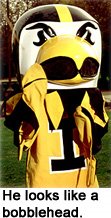
The university has a costumed Hawkeye, known as Herky, who has been a symbol of the university since 1948. The university had had gone through a number of mascots, including Burch, a black bear cub who lived under the football bleachers until he was found drowned in the Iowa River in 1910 (thankfully, KYF had an alibi). Herky was conceived by a journalism instructor and his name was selected based on a statewide contest and is supposed to be a shortened version of Hercules (so much for all that creative writing stuff). His first appearance at a football game came in 1959.

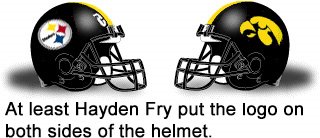
Colors/Logo/Fight Song – Black and Gold. But is it really gold? If I remember my Crayolas correctly, gold is what Purdue or Notre Dame wears. The “gold” on Iowa’s helmet is more of a corn yellow or, dare I say, maize. The colors have always been the same for Iowa, but the football uniforms purposely mimic those of the Pittsburgh Steelers. When Hayden Fry came to coach the Hawkeyes in 1979, his main task was to eradicate the atmosphere of suckness in the program – Iowa hadn’t had a winning season since 1960 before he arrived. Since Iowa had the same colors as the most dominant NFL team of the day, the Pittsburgh Steelers, Fry copied the wide stripe on the pants, and the black helmet with single yellow stripe. Whether it was the uniforms, or more likely his coaching ability and getting better players at Iowa, Fry turned around the Iowa program quickly and made it into one of the Big Ten’s best during his tenure.

The Iowa logo showed up at the same time as Fry, and the football team’s success since then has ensured that the logo will be around for a while. It’s actually a very clever design, consisting of four separate pieces to make up a hawk’s head. It’s not only the helmet logo, but is a symbol of all of the sports teams and the university itself. Just about any piece of Iowa memorabilia contains the logo.  Although we always kinda thought it looked like a certain cartoon character...


The Iowa Fight Song is rather generic, especially when compared to many of its Big Ten counterparts. The song only has 61 words, yet the word “Fight!” appears nine times. Even “Iowa” only shows up four times. Even the word “Rafters” shows up once, but that’s not surprising – this is a farming state.

You're supposed to be reading about
Iowa's academics. Shame on you.
Academics – Surprisingly, Iowa only rates as #72 on the U.S. News rankings of the nation's universities, tied with Big Ten cohort Sparty. KYF never would have imagined. The pride and joy of the University is probably the Writers’ Workshop. The Workshop is a two-year residency program which ultimately requires a creative thesis, usually a novel or a collection of stories, and its alumni have won a dozen Pulitzer Prizes with four graduates of the program having been named U.S. Poet Laureates. Oh sure, if Know Your Foe was in the hands of a Writers’ Workshop grad, it would be much more interesting.  But would you get pictures like the one to the right? (Like you're even reading KYF at this point)

Athletics – As mentioned above, Hayden Fry breathed life into the moribund football program starting in the early ‘80s. Though only appearing in three Rose bowls since then (and losing them all), the Hawkeyes are a consistently tough Big Ten opponent (at least for Michigan of late). But wrestling is where Iowa really shines.  Under legendary coach Dan Gable, the Hawkweyes won 20 national and 31 Big Ten titles. This included nine straight national titles from ’78 through ’86. So even though the basketball team has had some success, and the trampoline was invented by university members George Nissen and Larry Griswold around 1935, when you’re talking Iowa athletics, you’re talking wrestling.

Famous alums – While not a super-impressive list, they pick up points for being able to claim Tom Brokaw, John Irving, Tennessee Williams, Eddie Robinson and Gene Wilder (who was married to Michigan alum Gilda Radner). But they have to lose some points for having Tom Arnold, Ashton Kutcher, and Lou Holtz as alumni. And though she didn’t attend school in Iowa City, current U of M President Mary Sue Coleman held the same post and the University of Iowa prior to moving to Ann Arbor.

The Game – Saturday will be the last time Michigan great Denard Robinson suits up in the Big House. He likely won't play, but the Michigan fans (who show up on time) will be able to give him the tremendous send off he deserves. It's likely to be the only real exciting part of the day. Michigan should roll a truly bad Iowa team that's fortunate to even have the four wins on their record.


MICHIGAN - 35
IOWA- 9

Kamis, 08 November 2012

Know Your Foe: Northwestern 2012

Michigan welcomes Northwestern to A2 tomorrow for the Wolverines' penultimate home game of the 2012 season (I know, they grow up so fast, don't they?).  Michigan holds a 53-15-2 edge against the former Mildcats, including last season's game at Ryan Field (also known as The Big House West when Michigan plays there).  And yet it's the 7-2 Purple Cats coming into town ranked 21st in the Coaches' Poll and 24th in the BCS against the unranked Wolverines.  But you knew all that.  What you didn't know is all down below in the MZone's World Famous KNOW YOUR FOE: Northwestern 2012 Edition.

The Latin means "Holy shit,
this school's expensive
!"
HISTORY - On May 31, 1850, nine Methodist men gathered in a law office above a hardware store in Chicago to plan a university that would serve the former  Northwest Territory, a vast region that included what are now the states  of Ohio, Indiana, Illinois, Michigan, Wisconsin, and a part of  Minnesota. Though the school is non-sectarian, some religious overtones remain, including two biblical passages on its crest (along with untold souls mortgaged to the Devil after allowing the former football laughingstock to play in the Rose Bowl in the mid 90s). Since the departure of the University of Chicago in 1946, Northwestern remains the only private Big Ten School (with Ohio State the conference's only community college). Interestingly, Northwestern and U of C almost merged in the 1930s, but the plan was killed by the Northwestern trustees.  Sure, they would have created an academic powerhouse with potentially the worst combination of football teams since, uh, never.

LOCATION - Evanston, Illinois.  The village was named for Northwestern's founder, John Evans and has some lame nicknames like E-town, the City of Homes and -- wait for it -- Heavenston (I just threw up in my mouth a little bit). In the 1960's, the university changed the shoreline of Evanston by dumping landfill into Lake Michigan to allow more land for campus buildings.  On the not so Heavenly side of Heavenston: the relationship between the village and the university has turned a bit frosty as, per the founding charter, Northwestern does not have to pay property taxes. Ever. Sweeeet deal if you can get it (No, Exxon, you're not a college).

And although it's more a 'burb than a "college town," it's still a great place to live. A lively downtown, easy access to Chicago, and a beautiful beach (when it's warm enough) make Evanston one of the more desirable and expensive suburbs of Chicago. It's also home to numerous famous people, including the Cusacks, Jeremy Piven, Charles Gibson, Donald Rumsfeld, and Eddie Vedder. Not bad for a town of about 75,000.

NICKNAME - Wildcats, named by a Chicago Tribune reporter in 1924 (and thus not in honor of that shitty Goldie Hawn movie). Some of the school's previous nicknames include the Fighting Methodists and the fear-inspiring Purple. In 1972, with a nod to popular culture at the time (and probably just the overwhelming urge to get high), the student body voted to change the school nickname to "Purple Haze". It never stuck.

He looks like a Looney
Tunes character
MASCOTWillie the Wildcat is the costumed mascot for the university. The original mascot was a live bear cub named Furpaw (before they were known as the Wildcats). But in 1923, after a losing season, the university abandoned Furpaw (as a mascot) because they believed he was bad luck. If Northwestern continued this practice of changing mascots after bad seasons, they'd be on about their 80th mascot by now (although, before Pat Fitzgerald, they pretty much used to do the same thing with their coaches).

COLORS - Purple and White (which replaced Black and Gold in 1892).  In the '90s (1990s, that is) they were ahead of the current college football uni cliche and added black to their unis. And while black and purple aren't a good combo, this color addition corresponded to the time when Northwestern stopped being a laughingstock on the gridiron.  Thus, no surprise, they kept the black (as every other school seemingly added the color to the uniforms as well).

Logo - After struggling through the '70s to find a logo, Northwestern settled on their current version in 1981 and have not changed it since. The stylized bold N is sometimes adorned with a snarling wildcat, but the N is the symbol of the university and has been the only adornment to the football helmets for 25 years (not counting the grass and mud stains when they used to get their asses kicked game in and game out pre-Gary Barnett).


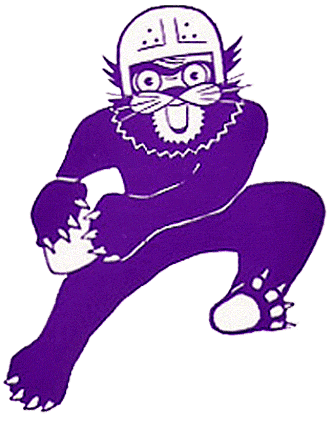
While the current N is solid, and has provided the university and its sports teams an identity for a long time, I think Northwestern made a mistake in 1967 when they went away from using this guy.


(Bottom logo from Chris Creamer's SportsLogosNet).

FIGHT SONG - The Northwestern fight song, Go U Northwestern, is a solid middle of the pack song for the Big Ten. Theodore Van Etten, inspired by a 20-7 victory over Indiana, wrote the song in 1912. Yes, it's pretty sad when your fight song was written because of a victory over Indiana - in football. The song was originally titled Go Northwestern Go but was changed soon after.

By the '80s, students and fans began yelling "Go 'Cats!" at the end of the song's chorus repeat which, if you ever witnessed N'Western football in the '80s was probably just a clever way of calling the team pussies.


ACADEMICS - Quite simply, Northwestern kicks some serious academic ass. They are currently the top school in the Big Ten according the latest U.S. News and World Report rankings, coming in at #12 (ahead of the second-ranked school in the B1G, #29 Michigan).

Maybe it's because of these high academic standards that NU has some traditions that sound as boring as they do intellectually inspired.  Take for example, Mayfest and Dillo Day.  According to the school website, "the roots of Northwestern's end-of-the-year celebration, Mayfest, reach back to the 1890s, when students would celebrate the 'renunciation of the May Queen of the temporal world for a spiritual one.'" 

 Uh...yeah.  I'll take Hash Bash, thank you very much.

Wait it gets worse better: "Nowadays, Mayfest is a weeklong celebration capped by a more recent tradition, Armadillo Day. In 1972, Northwestern students from Texas held a small celebration in honor of the armadillo. More than 25 years later, 'Dillo Day is the culmination of Mayfest and an all-day Saturday event on the lakefront with bands, games, and vendors."

All righty.

ATHLETICS - According to the Wikipedia article probably written by Northwestern's mom, "In the 2010-11 school year, the Wildcats had one national championship, 12 teams in postseason play, 20 All-Americans, two CoSIDA Academic All-American selections, 8 CoSIDA Academic All-District selections, 1 conference Coach of the Year and Player of the Year, 53 All-Conference and a record 201 Academic All-Big Ten athletes. Overall, 12 of Northwestern's 19 varsity programs had NCAA or bowl postseason appearances." 

Historically, it hasn't been as good. Northwestern is a charter member of the Big Ten, and promptly called dibs on the cellar. Though their women's lacrosse team has won 6 national titles, and their 1931 basketball team was proclaimed National Champs by something called the Helms Athletic Foundation, there have been few brights spots. Several low lights, including basketball and football players charged with bribery and point shaving, as well the infamous soccer hazing incident.

"Nation, last weekend USC coach and human weasel
Lane Kiffin was once again accused of cheating..."
FAMOUS ALUMS - Their alumni list is about as impressive as any in the country. When you combine a powerful academic school with one that's also strong in high profile areas such as drama and journalism, you're going to get a list with a ton of people that everyone knows. From the entertainment field you have Ann-Margaret, Zach Braff, Cindy Crawford, Marg Helgenberger, Charlton Heston, Shelly Long, Julia Louis-Dreyfus, Jeri Ryan, Seth Meyers, David Schwimmer, Zooey Deschanel, Kimberly Williams and Warren Beatty (although a good number of these folks didn't graduate). That's a pretty good babe quotient there too. From the business world Northwestern can claim the past and present CEOs from companies such as Wells Fargo, Motorola, Paramount Pictures, Office Depot, AON and some company we've never heard of, Playboy. Numerous journalists are NU alumni including Christine Brennan, Gregg Easterbrook, Rachel Nichols, Michael Wilbon, and Brent Musburger. Former Obama Chief of Staff Rahm Emanuel.  And Stephen Colbert. That pretty much trumps any astronauts or athletes that Michigan might be able to brag about. The school has also produced a number of presidential election losers (William Jennings Bryan, George McGovern, and Adlai Stevenson) and just plain losers (Rod Blogojevich, Jerry Springer), but no Presidents.

THE GAME -   While NW is 7-2, those wins are about as impressive as Michigan's 6 -- i.e. not so much.  The only team they've beaten with a winning record is the same 5-4 Gopher squad Michigan stamped out last weekend.  In fact, Northwestern's best win may be a 29-28 loss at home to Nebraska (and we use the term "home" loosely even though the game was in Evanstan as there were way more Husker fans).  So I guess this weekend we find out which team is more legit...ish.  While KYF thinks the opening 13 line was a little high, after Devin's breakout and playing in The Big House, go Blue:

Michigan -31
Northwestern - 24

Jumat, 02 November 2012

Know Your Foe: Minnesota 2012

There I was -- swamped at work this week.  But since we moved Rigby to the Photoshop position, Andy to wallpaper specialist and with Benny having transferred from the MZone during our last hiatus, we were left without a capable back-up blogger to step into the starting line up to do Know Your Foe.  Luckily, my work situation healed in the nick of time.  So after a couple practice tweets to make sure my blogging skills were okay, I sat down at the computer and...

Tomorrow, Michigan faces Minnesota for the 99th time, with Michigan holding a commanding 71-24-3 advantage in the series including last season's 58-0 bludgeoning in A2.  Both Michigan and Minnesota are 5-3 but the Wolverines are 3-1 in B1G play while the Golden Gophers are 1-3.  Of course you knew all that.  What you didn't know is below in this week's installment of Know Your Foe - Minnesota 2012.

This looks like some coin
recovered from a shipwreck
History – Founded in 1851, the original campus overlooked the Saint Anthony Falls on the Mississippi River (yes, the Mississippi divides the Twin Cities), but it was later moved about a mile to its current location. During the Civil War, the school shut down following a financial crisis (probably The Jessup's Trading Post, Saloon and Bank mortgage meltdown caused by those shitty Louisiana Purchase derivatives). It reopened in 1867 - with the help of Minneapolis entrepreneur John Sargent Pillsbury, (yes, that Pillsbury) - and was upgraded from a preparatory school to a college in 1869. There was no graduating class until 1873 when two students received their diplomas (and thus setting the stage going forward for the all-time shittiest class reunions in recorded human history).

Location – The Twin Cities of Minneapolis and St. Paul. Yes, there is a campus in each city, kind of like North Campus and Central Campus in Ann Arbor (they even have their version of the Bursley Bus connecting the two). Though the winters in Minnesota last about 11 ½ months, the Twin Cities are actually a fun place. There’s a legacy of great music – Prince, The Replacements, Husker Du and Lazy Bill Lucas (props to Bill for overcoming his laziness and making something out of himself). Mary Tyler Moore lived there, too.

You've got a dental school - use it
Nickname – Golden Gophers. Goldy the Gopher to be exact.  After being chosen as the state's official animal in 1857, Minnesota was declared the Gopher State. Taking advantage of this natural connection, Minnesota football coach Clarence Spears named his team the Gophers in 1926. Several years later, Bernie Bierman’s champion football team was coined the “golden swarm,” a reference to their gold-colored jerseys, and the team soon became known as the “Golden Gophers.”

Have to say, a mascot named after the vermin/varmit/varmint from Caddyshack doesn't quite strike fear into an opponent's heart.  Plus, even with such a fine dental school on campus, you'd think the actual Minny mascot would get his teeth fixed by now.

We're told Goldy "energizes thousands of student fans as they chant 'Ski-U-Mah,' a rally cry that means 'Victory UM.'" We at the MZone think it actually just means "another reason not to have a mascot roaming the sidelines.  Ever."

Dreads on your QB?  Nice try, Minnie
Colors/Logo –Maroon and Gold.  While they use Goldy the Gopher a lot as a logo, on their helmets, they have that funky "M" with those weird serifs on them. They’ve had some version of it on their headgear since at least 1968. This year they rolled out new uniforms and were so excited about it, they made a YouTube video.  Woo hoo!  They also sport new helmets this season which have a "textured maroon finish."  At least they didn't succumb to the all-black uni craze sweeping college football.

Fight Song - The Minnesota Rouser is a very underrated fight song, though the title sounds like a porno movie from 1955 or a drink somebody talks you into trying at 1 a.m.  The song was originally known as Minnesota, Hats Off To Thee, and was written by a church choir director. Know Your Foe practically guarantees you've heard it and you might have even hummed it to yourself without even knowing whose fight song it was.

Academics – According the latest U.S. News and World Report Ranking, Minnesota is the #68 National University, same as last year. That ties it with Clemson, Rutgers and BYU - and places them ahead of #72 -- Michigan State (Suck it, Sparty).  It has a total undergad population of 34,812 and accepts just under 47% of its applicants

In his 2007 Minnesota KYF, Benny claimed that the pride of the University is the Hubert H. Humphrey Institute which ranks among the top 15 professional schools of public affairs at public universities in the country. I beg to differ.  According to the U.S. News and World Report Ranking linked above, the school is 52% female and apparently has coeds going there like former American Idol contestant and bikini calendar girl, Casey Carlson, shown here:

Must...resist...making..."little brown jugs"...joke


Stadium/Fans - The Gophers got a shiny new home for football in  2009 called TCF Stadium which is sometimes referred to as "The Bank" or "The Gopher Hole."  Unfortunately for the football team, as is often the case with gopher holes in real life, usually others simply come and destroy what is inside leaving nothing but greasy, grimey gopher guts behind.

Athletics – If it weren't for hockey, wrestling and football glory from over 50 years ago, the sports tradition at Minnesota would be pretty lame.  Academic fraud wiped out their lone Men's basketball Final Four appearance (as opposed to the cheating that wiped out our most recent Final Fours in the early 90s). But Williams Arena is one of the more unique places to play with those sunken benches. How no one gets hurt diving for a ball, I don’t know. Plus it forced former head coach Clem Haskins to sit on a bar stool, which was kind of cool.

Famous alums – Kind of like their sports teams, good but not great.  From actors such as Loni Anderson, John Astin, Peter Graves, TR Knightm Kate Mulgrew, Ron Perlman and a Ghostbuster; to a number of Congressmen and cabinet members you've probably never heard of unless you're from Minnesota; to business leaders including Robert Gore, the inventor of Gore-Tex (the cold weather material, not the robotic inventor of the Internet).  In the Space, Bitches, Space category, they have two astronauts.  And they have two Vice Presidents but, alas, no presidents.  However, they do have Erica, Nicole, and Jaclyn Dahm of Playboy fame.

The Game – Minnesota started the season 4-0, beating UNLV, New Hampshire, Western Michigan and Syracuse then dropped three in a row to Iowa, Northwestern and Wisconsin before bouncing back last week against the corpse that is Purdue. Blah, blah, blah, blah, blah.  Is Denard healthy?  He is?  Okay:

Real U-M -28
Other U-M -10

Kamis, 25 Oktober 2012

Know Your Foe: Nebraska 2012

The Wolverines travel to Lincoln, Nebraska tomorrow to face the Cornhuskers for the 8th meeting between the two schools.  Michigan holds a 4-2-1 record against Nebraska, including last season's 45-17 beat down in A2.  Will the Wolverines be able to generate some offense against a team with a pulse?  Will the defense be able to stop Taylor Martinez?  Unfortunately, we can't answer that.  But we can answer everything else you need to know about Michigan's opponent in the latest thrill-fest known as KNOW YOUR FOE: Nebraska 2012.


The seal looks like
the wheel from
Wheel of Fortune.
History – The University of Nebraska was created in 1869, two years after Nebraska achieved statehood. The Nebraska legislators elected to create one unified University in the state, unlike their uppity neighbors Iowa and Kansas. That's why we don't have a Nebraska State University. The first two degrees were granted in 1873 and I can't help but wonder if the guy who was second in the class ever admitted to being last in his class. The first 20 years of the school were marked by small classes and lack of funds before a late-century boom took the enrollment to around 1,500 students. Near the end of the 19th century it was the 15th biggest school in the country. Growth continued into the 20th century with the development of the farm campus (seriously), which is now known as East Campus. The school is formally named the University of Nebraska-Lincoln and is commonly referred to as UNL, NU (which makes no sense) or simply Nebraska or also that school that had to beg for a share of the National Championship in 1997 as a going away present for Tom Osborne.


Hey look, there's a star above Lincoln!
Location – Lincoln, Nebraska. Lincoln is the second largest city in the state (behind Omaha) and is one of five state capitals that also house Big Ten teams (along with St. Paul, Columbus, Madison and Lansing – it’s close enough). It’s nicknamed the Star City because it’s the capital and state capitals are represented by stars on a map (Know Your Foe is a bit of a map geek and even we find that lame. Not quite the “Big Apple” of "Windy City” for sure).

There’s a 20 foot statue of a
farmer up there – pretty cool.
The city was obviously named for Abraham Lincoln but that decision was, believe it or not, met with controversy. The village was originally founded as Lancaster in 1856 when the capital of Nebraska territory was in Omaha. Legislators wanted to move the capital closer to more densely populated part of the state so they chose Lancaster as the new capital. However, some legislators who were against the move tried to derail this plan by renaming Lancaster to Lincoln after the recently assassinated President. They knew this would be met with hostility since many residents were sympathetic to the Confederacy in the recently completed Civil War. But the ploy didn’t work and even though Lancaster became Licoln, it was still named the capital upon statehood on March 1, 1867.

Lincoln’s main industry is service, and the economy is driven by the university and the state government. There are virtually no suburbs as most of the land around the city has already been annexed. The town is home to the second tallest capitol building in the U.S. and is the hometown to erudite talk show host Dick Cavett.


Nickname – Cornhuskers. There's no conference in the country with the variety of excellent nicknames that the Big Ten has. With the exception of the Wildcats, and maybe the Spartans, each Big Ten school boasts a nickname that are unique and instantly identify their teams. This might've been the best reason to allow Nebraska into the conference. Cornhuskers is absolutely unique and brings to mind only one thing: Nebraska. So much so that the state officially co-opted the nickname in 1945.

Before the turn of the 20th century, the Nebraska football teams had a number of nicknames including the Old Gold Knights, the Antelopes, the Tree-Planters, the Rattlesnake Boys, and the Bugeaters, which was their most popular name until 1900. At that time, Lincoln sportswriter Cy Sherman believed that the Nebraska team deserved a more glamorous name. The Iowa teams at that time were sometimes referred to as Cornhuskers and Sherman thought that name was better suited for the Nebraska team. Besides, Iowa fans were partial to one of their other nicknames, the Hawkeyes. The Cornhusker nickname stuck and Sherman went on to a 60-year sportswriting career and is credited (or blamed) for originating the AP football poll that still rues its ugly head over college football to this day (Hell, they even include disgraced Ohio State in their poll this season).

Mascot – Herbie Husker. The Cornhuskers went through a number of mascots, starting with Corn Cob in the ‘40s and ‘50s. Yes, this was a guy wearing a giant corn cob head. 1962 saw the arrival of Husker Man who looked like Purdue Pete’s alcoholic brother. Husker Man didn’t stick around very long and gave way to another anthromorphic corn cob, Mr. Cornhead, in the mid ‘60s (who looked like a weird condom with a red hat on top). Harry Husker then took over in 1965. Is there any doubt he was based on numerous boosters who set fire to the NCAA rule book?

The corn cobs are cool - the humans are seedy looking.
Finally, in 1974 Herbie Husker was born. He was the result of the incredible cartoonist Dirk West. Seriously, check out his work – brilliant on so many levels. West created Herbie for the 1974 Cotton Bowl and later refined the character who would then be used as the mascot for all Husker teams since. He underwent a major transformation in 2003, losing the gut and getting quite cut (unlike actual Nebraska fans). He also lost the dye job and is now a brunet. All of this surely helped him win the national mascot of the year in 2006. In 1994 Lil’ Red joined the Nebraska mascot family. The inflatable dude is the nightmare Michigan fans had when Dave Brandon floated the idea of a Wolverine mascot for kids to take pictures with.
I prefer original Herbie - he
had a corn cob in his pocket.
Colors – Scarlet and Cream. One of only eight schools to call their red scarlet, they’re also one of only three NCAA schools that count their white as cream (along with Indiana and Oklahoma). Know Your Foe has stated our problem with red (or scarlet) over the years here on the MZone. Suffice it to say, it’s just too common. No wonder the Huskers gave up so many points to Ohio State earlier this season – they probably didn’t want to tackle anyone wearing the exact same colors as they were wearing. Besides, scarlet and cream sounds like a delicious ice cream flavor.
The colors haven’t changed in Lincoln for over a century. At one point the team wore gold as evidenced by the Gold Knights nickname in use in the late 19th century. But the scarlet and cream combo has been a Nebraska tradtion since the Cornhusker nickname came into being in 1900. The only slight deviation is the reference to the Nebraska defense as the “Blackshirts.” This nickname is in reference to the black practice jerseys worn by the first team defense in practice and dates back about 50 years when legendary head coach Bob Deveney wanted the defense to wear a contrasting color to the offense’s red scarlet. Thankfully the Huskers haven’t succumbed to the uniform nonsense of late and haven’t gone to a black uniform. Yet.

Looks like something
from Laugh-In.
Logo/Helmet – Since 2004 Nebraska has gone with a simple red block N and for the ten years before that they superimposed a script “Huskers” over the N. Unfortunately these recent logos feed the stereotype about the state – flat and boring. But in doing research for this piece, Know Your Foe was fortunate enough to find HuskerJ’s page of Nebraska’s mascots and logos. Scroll down and check out the absolutely groovy logos from the early ‘70s. Far freakin’ out. How could that possibly come from the same school that’s used the block N for twenty years?

No need to mess with this.
Nebraska’s helmet might not be as flashy as whatever crap Nike’s been pushing on everybody, but it’s solid as hell and has been virtually unchanged for over 40 years. A simple white shell, a scarlet stripe down the middle and a plain but elegant N in the middle. The only change since 1970 was the move to a red facemask for the 1982 Orange Bowl. Nebraska’s helmet history is about as boring (and great) as that of Michigan. Sure, they had NU on there for a a couple of years in the ‘60s and numbers before that. But the current Nebraska helmet is as iconic as any in college football. Let’s hope it stays that way. (As always the helmets are courtesy of the excellent Helmet Project.)

Fight Song – Apparently the Cornhuskers have at least two fight songs. According to this source, they play Hail Varsity after a touchdown, and There’s No Place Like Nebraska (also known as Dear Old Nebraska U) after the extra point. It’s unclear what they play after a field goal or a safety. If There’s No Place Like Nebraska sounds familiar, it should. It’s extremely similar, if not the same, as Florida’s fight song, We Are The Boys of Florida. How could two powerhouse football programs - who met for the national title in the 1996 Fiesta Bowl - have the same fight song? Evidently, they also share the song with the Toledo public school system.

The lyrics to the two songs are quite different. Hail Varsity is pretty standard fight song fare, with a touch of communist march – heavy on loyalty, a politically incorrect sexist bent, and talk of fighting for victory.

Hail to the team!
The stadium rings as everyone sings
The Scarlet and Cream
Cheers for a victory echo our loyalty
So on mighty men!
The eyes of the land upon every hand
Are looking at you
Fight on to victory
Hail to the men of Nebraska U!

There’s No Place Like Nebraska on the other hand is much more charming and unintentionally funny (not to mention a better tune). Any song that mentions that the women are hot, the men are nerds, and the weather sucks is OK with us. The only questionable lyric is the “true blue” mention. That might not fly with Cornhusker fans this week.

There is no place like Nebraska
Dear old Nebraska U
Where the girls are the fairest
The boys are the squarest
Of any old place that I knew
There is no place like Nebraska
Where they're all true blue
We'll all stick together in all kinds of weather
For dear old Nebraska U.


Academics – According to the most recent U. S. News' ranking of America's Best Colleges, Nebraska is 101st, same as last year by far the worst rating for any Big Ten school. Even Sparty is ranked 72nd. Nebraska's tied in the rankings with such academic powerhouses as Iowa State, UC-Riverside, Oklahoma and Tennessee. Maybe the N on the helmet stands for “knowledge" (I know: an oldie but a goody).

Athletics – Nebraska is in their second year in the Big Ten and was a charter member of the Big 12 Conference (and all its various incarnations) in 1907. It’s too early to tell who the Cornhuskers’ rivals will be in the B1G, but ack in the ‘70s and ‘80s there was none better than Nebraska-Oklahoma on the gridiron. However, when the Sooners moved to the South division of the Big 12 they didn’t meet every year which was completely stupid (are you listening, Dave Brandon?). There was an attempt to make Colorado a rival but that never really took.


When this guy's your
all-time leading scorer
you have a bad program.
The Huskers field 21 varsity teams (Michigan has 27), including women’s bowling and women’s rifle (hey, it's Nebraska). The women’s volleyball team is one of the most storied programs in the country. It must be all the beaches in the state that produce such great players. Nebraska has won three NCAA titles (1995, 2000, and 2006), has been a runner-up three times, and has five other final four appearances. The Cornhuskers are second only to Stanford in titles and winning percentage. The men’s gymnastics teams have won eight national titles, though none since 1994, and the women’s track and field team has two national titles, though none since 1984. The men’s basketball team has been a disgrace. They haven’t won a conference title since they shared the Big Seven title in 1950! Know Your Foe didn’t even know there was a Big Seven. They haven’t won an outright conference title since winning the Missouri Valley Intercollegiate Athletics Association in 1916. They’ve never won an NCAA tournament game, they’ve made only six tournament appearances, and their first trip to the tournament wasn’t until 1986 (but they did make the NIT last season).

When it comes to Nebraska athletics it’s football, football, football. The Huskers began playing football in 1890 and have won 46 conference titles and have won or shared five national championships, including the undeserved share of the 1997 title. Only Michigan and Texas have won more games than Nebraska, with Michigan's 900 tops. Only Rutgers has played more football games than Nebraska (who’s tied with Navy and one game ahead of Michigan), and Nebraska’s all-time winning percentage is 8th best (Michigan, again, is tops). Not only has Nebraska had tremendous on-field success, but they’ve sold out every game since November 3, 1962, an incredible streak of 322 games.

Maybe Carnac knows
who will win on Saturday.
Famous alums – The list of Nebraska alumni isn’t all that impressive (with two exceptions). They’ve had their share of academics you’ve never heard of, some legal figures of low to moderate fame, and, of course, plenty of great football players from Heisman winners Johnny Rodgers (1972), Mike Rozier (1983), and Eric Crouch (2001), to great NFL’ers like Roger Craig, Irving Fryar, and the Detroit Lions’ Ndamukong Suh. But what the Nebraska alumni list lacks in volume it makes up for with quality at the top. Other schools may have more well-known business leaders, but Nebraska boasts one of the wealthiest people in the world and one of the most successful investors ever in Warren Buffett (B.S., 1950). I would imagine he has no problem scoring Husker tickets despite the sellout streak. And though other schools can lay claim to plenty of greats in the entertainment field, Nebraska can top them all with alumnus Johnny Carson (1949). For those too young to know, Carson owned late night TV for decades and paved the way for David Letterman, Jay Leno and pretty much all the rest, not to mention hundreds of comedians. Good stuff.

Three Nebraska graduates have been U.S. senators, five have been U.S. governors, and one was even the president of Latvia, but, alas, no U.S. Presidents

The Game – Boy, I have no idea here.  It's a) on the road b) against an offense that's leading the B1G in points and YPG.  Then again, "NU's" defense is tied with mighty Purdue in giving up 27.7 PPG and is tied with the B1G's real NU with the lowest number of INT's at 3 (a very positive stat as far as Michigan's concerned for reasons KYF doesn't need to explain).  Nebraska has beaten 6-2 Wisconsin and 6-2 Real NU, two better wins than Michigan can boast, while losing to 5-2 UCLA and getting bitch-slapped by 8-0.  So I think it's a coin flip and don't expect a blowout either way.    With Michigan coming off an emotional win against MSU and the game on the road, unfortunately I think that could be the difference:

Michigan - 18 (5 Gibbons, 1 Wile FG)
Nebraska - 20