Well, it's finally here! For those that have doubted the technique, a dear friend of mine, and colleague, Coach Barry Hoover, who runs Coach Hoover's Football Coaching Site, has done all the leg work for me in finding the proper cut-ups for the film and putting it all together. I can take no credit here, Coach Hoover's a fine individual, who by the way, can tear up some BBQ!!! Anhow, here is the film, hope everyone enjoys it!
Some other things to look at this off-season:
Brophy stirring the pot with Florida State and Mickey Andrew's famous "jet" technique and pass rush technique in his latest blog post. He also has another good post on the "In, At, Out" Drill for LB's.
Some other sites to check out are in my blog roll. Always give these guys a look, there's some good stuff out there!
Smart Football
Hit Em' Hard
Spread Football
Blitzology
Compete in All Things
These are just a few in my blog roll. Great stuff out there written by great coaches that take time out of their busy schedules to help us out. Thanks guys!!! Dog days of summer are here, don't get lacidasical!!!! Season's right around the corner.
Duece

Tampilkan postingan dengan label 4-3. Tampilkan semua postingan
Tampilkan postingan dengan label 4-3. Tampilkan semua postingan
Selasa, 02 Juli 2013

Jumat, 05 April 2013
University of Nebraska Linebackers Clinic
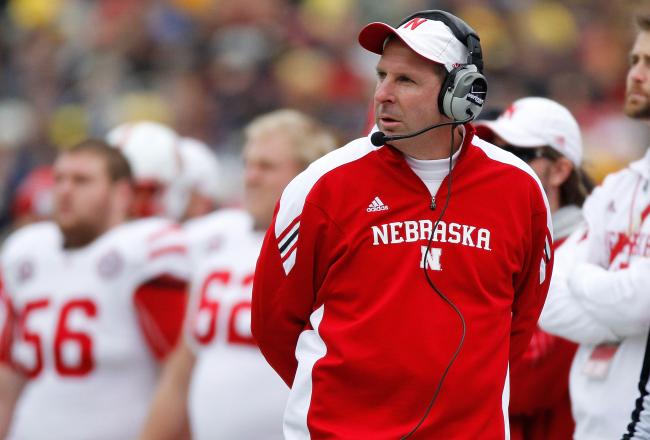
I had the opportunity, back in December to watch the University of Nebraska practice for their bowl game against the University of Georgia Bulldogs. After that practice, the coaches held a small breakout session that was quite informative. Since I've been a LB's coach over the past 3 seasons, I figured I'd go check out their LB's coach and see what he had to say. Needless to say it was a very informative session, and here are my notes from the clinic. Hopefully you can find some good information in this stuff like I did. If you are interested in their defensive backs, Coach Hoover went and listened to their DB coach speak, and you can check out his post on the matter here.
Linebackers
· Tackling Progression
o start from scratch
· 8 Drill Categories
o Agility
§ General footwork
§ Types of game movements
· Duplicate and repeat game movements
o Watch film to see how to do this (never lies)
· Make players bored with your drills
§ Quick Box

· Align a 5 yard box with LB's facing coach. LB approaches and coach points to cone, LB must get to cone, and then react to coach's next signal.
· Great change of direction drill with constant movement
§ 10 Dots
· Align dots or cones in a series and have LB's try to get through them as fast as possible
§ Flip Hips
· Use a line and stay on that line
o LB must sprint
o Don't make drill predictable
§ 45 Degree Break
· LB drops away from you and reacts to your pointer
· LB should break and open hips when you change the pointer
· If the LB jogs, then simply make him keep running until he gets the idea
o Footwork
§ 1st step is based on the RB's movement
§ They take a lateral step and replace
§ They move with that shuffle until something declares
§ Shuffle Drill
· 10 yards
· LB's shuffle between yard markers (1 yard), back and forth staying between the tick marks (use dummies)
§ Shuffle Break Drill
· Same as shuffle drill, but at the end make them break and intercept a pass, or scoop and score
§ Shuffle with bags
· Good drill with high reps

· 1st LB on command shuffles to end of 1st dummy and reacts to coaches command to either go forward (sprint to the next dummy), or break and cross over to the opposite side.
· Once 1st LB goes, 2nd LB aligns on same side as the 1st LB on 1st dummy. Both will then react to the coach's command.
· The 3rd LB will then repeat what the 2nd LB did, so that you don't have guys standing around waiting on 1 guy to do the drill.
§ Leverage
· Don't give a RB a 2 way go

· Set 1st cone 3 yards deep and 2nd cone 5 yards deep
· Put RB between the 2 cones
· LB aligns on deeper cone
· RB will run to shallow cone and can either cut upfield or cut back (no juking)
· If RB cuts back, LB makes good physical tackle
· If RB cuts upfield, then LB must flatten and run feet, driving like crazy as he has no leverage.
o Drill is done to prevent the cutback
§ Double Leverage Drill
· Same as leverage but now with 2 LB's
o Double the work
o Same reactions for both LB's
§ Space
· LB aligns on hash and WR on top of #'s

· Coach throws ball to WR (can just make motion if you can't throw-better this way b/c WR doesn't have to catch the ball)
o If you don't throw it, have coach hold WR for a second to mimic game speed on fast screen
· LB attacks landmark and does not allow WR to cutback (similar to leverage drill but done in a much larger space)
· WR goal to get 10 yards, LB goal to stop him from getting 10 yards
§ Shuffle-Alley-Shuffle

· RB starts out jogging down yardline, and will alternate between jogging and sprinting (you can control with whistle if need be)
· LB should shuffle when RB jogs (don't give up the cutback, backside leverage) and sprint with shoulders square when RB sprints
· RB has 2 way go after 3 or 4 reps and can cut back or try and out run the LB
o Vs. cutback LB makes tackle, Vs. run away LB runs feet and makes leverage tackle (combo of leverage drills)
o Blocks
§ Shock the blocker (head and hands)
§ Shock and then get off
§ Keep it competitive
§ Shock sled
· Sled they have they use in early season and off-season
§ Shock drill (vs. a man)
· Set up OL and LB with LB in a shade in one direction or the other
· LB/OL should be the same distance apart as they are in a game
· Have OL execute a scoop or zone block, LB should attack (shock) the blocker and then get by with a push-pull move (doesn't care to rip, only after push-pull does he tell his guys to duck their arm under)
· Set up a cone to either side that the LB/OL cannot go outside of
· LB should shock the OL, release and then burst upfield
· Can do this drill in multiple groups
o Tackling
§ Leverage drill
§ 3 yard box
· RB on 1 end, LB on the other of the 3 yard box
· On command RB will move lateral between cones, while LB shuffles to mirror him
· On command, RB attacks LB head up (no juking) and LB must make a face-up tackle and drive legs
o Similar to "mirror drill"
§ Low Tackle
· Tackler wants his body at the center of gravity of the ballcarrier
· Step on the RB's toes
· Wrap and twist once contact made
o Wrap dummy, land on dummy and then roll completely over
o Pass rush
§ Attack the middle of the RB & flip hips to get by
§ LB should slap RB hands down as he's flipping the hips
§ Can create this using a standup dummy and have LB blitz the dummy, slap at the dummy and flip hips to get around the dummy
· Once clear of the dummy LB should accelerate
· Can also do this drill to imitate a blitzer coming off the edge
o Play on Ball
§ Teaches the strip
· "Start the lawnmower"
o Many kids nowadays not familiar with lawnmower tech
§ Key is to lift elbow and punch the ball downward
· Only done when ballcarrier is secured
§ Can add scoop and score to any agility drill
§ Play on Ball
· Reach with long arm, knock ball down and turn back to QB
o Make them do the drill 1-armed -no pass interference
§ Put their near hand in their pants to do this
· Reads
o They key RB's, because when you focus on something further away you can see more than focusing on something that is close
§ OL can give false keys
o If LB's having a tough time reading, vary their depth off the ball
o Make their first step lateral, then have keys that make them attack downhill
§ "Slow til' you know"
§ All their drills are shuffle and read
§ This depends on the leverage of the LB too
· This also depends on what your opponents run
o They see a ton of inside/outside zone
Senin, 06 Juni 2011
The 4-3 Scream and Splatter
I came across this defense, by sheer accident (which you may download here) several years ago while helping a friend. I had a phone call one evening from an old college friend who was the head coach (HC) and offensive coordinator (OC) at a small school in Southwest Florida (SWFL) and was facing a team that had an ultra-aggressive 4-3 defense. He sent me some film on them, and was trying to figure out how to attack them with the split-back veer. After watching several films on this opponent I was very intrigued to see the radicalness of the defense. The interior tackles sat in 2I's most of the time, and the defensive ends (DE's) were in a radical tilt, almost ninety degrees to the traditional way of aligning. The DE's looked right down the line of scrimmage (LOS) to the ball. The outside linebackers (OLB's) were stacked right behind these ends at about four to five yards off the LOS. The middle linebacker (MLB) was the same depth and directly over the center. The DE's were the kicker though, they came off the LOS like missiles, and simple put, wrecked everything in their path. It was quite astonishing to watch, and I could see why my friend was calling, as they were a very rambuncious bunch to try and move the football against. The secondary seemed to be playing some sort of two deep man under coverage, maybe even a version of quarters. The corners appeared to be in man with the safeties twelve to fifteen yards deep, and rocking back on the snap. They would rotate the secondary into cover 3 when they got trips or twins, they never broke the box, always keeping their 4-3 intact. The defense was aggressive and attacking in nature and they, simply put, got after your ass!

The conversation, and films led me to try and research the defense, however, information was not easily obtained. One day when posting on the Huey board, I had a coach, from Wisconsin respond to me and tell me about a "tilted 4-3" in their area that was similar to the defense I had been describing in my posts. He told me to check out Lancaster High School, in Lancaster WI. So I gave their head coach a call, and he directed me to their defensive coordinator (DC) who was very helpful. He sent me information on the defense, and told me they got it from somebody out in California. He did not elaborate but we spoke several times about his defense, the pros, the cons etc. Over the years, from my first post about the defense, people have contacted me and asked me about it. I wanted to put a post out here that some may use, to get a first-hand look at this defense. I want to preface, I did not run this defense, I merely took some things out of it, that I will discuss later. I am going to break down the defense from the ground up, and then go into what I used out of each section. Hopefully this will shed light on a very aggressive and attacking 4-3, that some have never seen. Shall we?

Defensive Line
In the Scream and Splatter (S&S) defense, all 4 of the down linemen are tilted at a forty-five degree angle to the LOS. The basic shades are your standard over front shades with a one and five techniques to the weakside, and a three and nine technique to the strong side. The defense I saw on film, did not do this, they had 2I's in the interior, and the strong end played a seven technique (inside shade of the tight end). The reasoning behind the tilt is to better facilitate our old friend, block down, step down (BDSD). The author of the defense explains that this allows them to execute the "splatter" technique against gap blocking schemes. As far as defensive line manuals go, this one is not much different except for the tilt. I got some film on Lancaster, and they are not your "war-daddy's" by any means, but they do get after it. The main reason is the simplicity in the teaching of the defensive linemen (DL). They key their "trigger" as it is called and react from there. After that, they have the normal reactions to the blocking schemes that you see most four man front defenses doing these days.

The other key for the DL is the actual "splatter" technique. This is practiced daily, and there is a diagram in the packet they sent me of how to set up the splatter drill. The interesting thing is they do not talk about depth or angle, they simply talk about getting off the ball, and coming down the LOS and attacking the upfield armpit of the blocker. The diagrams basically speak for themselves, so I will not elaborate further.
I did not tilt all four of our linemen, the number one reason is that we were seeing so many zone teams, I felt it would allow our inside guys to be reached too easily. I did tilt our DE's, but not radically like the SWFL team mentioned earlier. We simply put our inside had down, and then turned our body inside enough to see the football. I actually changed our term wrong arm to Lancaster's term splatter and it's quite a funny story. In my first year as a DC at my last gig we were teaching kids the wrong arm technique when I overheard one young player tell another "why are we learning this, if it's the wrong way to do it". Ahh, the teenage mind! So, after that, we decided to call our wrong arm, the splatter. The kids liked it, it made sense to them, and the rest is history!
 |
| "Gnarly dude" |
Linebackers
The linebacker play in the S&S defense is what really caught my attention. The way they taught it, seems overly aggressive, yet there was an effectiveness to it, that I bought in to. All three linebackers (LB's) read the fullback, or near back in offset backfield sets. The LB's had but one read, intersect the path of the FB. That's it! All they had to do, was to intersect that path, and leave the rest to the safeties behind them (we'll talk of that later). This made for a defense that looked as though it was blitzing every down. The LB's seemed almost a step ahead of the opposing offenses on film. It was quite a sight to watch. Now, I know what you are thinking, "Why not just run counter?". You would be right, but the safety play behind it, made this nearly impossible. The LB section shows the drill on how to teach the LB's to intersect the path of the fullback. They set up trash cans and ran through all the various series of plays, and how the LB's should react to these (they called it the "Barrel Drill"). The other interesting thing is that they involved the safeties in this drill as well. As you will see in their run fit section, this safety involvement is critical to the defense.
We took the basics of this read system and used it, however we added a few other things to it to help us with the counter runs and bootlegs. Our MLB, had these exact reads, but our OLB's had a few other things added to it. I also started using our safeties in run fit drills, and in inside run drill. This payed huge dividends as it allowed the safeties to see just where they should fit, with out having to worry about the pass threatening them.

Defensive Backs
The safeties were the crux of the S&S defense. They were the "clean up" guys. Basically, they made the LB's underneath of them "right" by fitting where needed. Now, the S&S isn't for the faint of heart, as they sit in cover 0 all the time. Yep, that's it, one coverage! As you can see, they wanted to keep things simple. So, back to the safeties and how they "fit" into the defense. The safety on the action side of a run play, was no different than your quarters or 2 read safety in that he was the force player. The backside safety was the kicker, he had to clean up all counter, bootleg, and reverses. The backside safety made the LB furthest away from action, be able to "scream" to the football without fear of the cutback or the counter. This was important because it led to the defense outnumbering the offense at the point of attack (POA). This is exactly how I played it out of my 2 read/Blue coverage scheme as we've read before (go here if you haven't already).
The corners in this defense are primarily man to man guys. In the playbook you can see that they gave the corner 6 basic reads and worked those to death. I've often had this philosophy myself, corners have a tough enough job, no need in worrying them about the run. Well, the S&S is perfect for your cover corner.

The S&S in Recent Years
I have not had the luxury of talking to Lancaster's coaches in over 3 years now, however the last time I talked to them, they were having some problems with spread formations, most notably 2x2 teams that ran zone read. I have no doubt that they have come up with a scheme to defeat these offensive tactics in the recent years, as many on the Huey board have said they still remain an elite team in Wisconsin.
In Florida, my buddy tells me nobody runs the defense that got my interest started all those years ago. It's a shame, as the coach that ran it, according to my friend had a very impressive record to go along with his defense. Nonetheless, the defense has gone the way of the Dodo bird in that particular area.
I hope this was insightful to those who have been asking about the defense. I think the S&S has excellent merits, and is a sound system that seems very simple to install. I know it caught my eye when I first saw it, and I definitely stole all I could from the information I gathered on the S&S. Please feel free to email me about this topic, however, please remember I did not run this defense in its entirety, only select portions. Here is some footage I got from Lancaster, sorry about the cutup quality, I had to cut it myself. Enjoy!
Coach Hoover has a GREAT article on "How Much to Install". He's a man after my own heart, especially linking to the great Tony DeMeo.
Football-Defense has a very good article on the basics of Turning a Program Around. Very good read, and a very good site, I must say.
Over signing won't ruin the SEC, writes Chris Low in his ESPN blog. Something tells me he's right, and I love Steve Spurrier's quote at the end of the article. The Ol' Ball Coach is still a hoot!
Duece
Kamis, 17 Maret 2011
Backside Safety in Quarters Coverage vs. The Run and Playaction
For the Quarters coverage newbies out there, I thought I would share a little blurb about the back side safety in run support out of Quarters coverage. Now why on Earth would I have a post about that topic? Well, to be honest, both safeties in Quarters coverage schemes are equally important, however if I had to rate which one was more important, it would be the safety away from run action. I'll tell you why. Lateral plays that get outside can be trouble, and we all know (or should know) that to the run action side, the force player is the player that makes things go. However, the really troublesome, and demoralizing plays are inside runs that cut back against aggressive defenses and come out the back side for big, and often times huge gains. This is where that back side safety is so critical in the run support scheme for your defense. So let's take a look at correct and incorrect methods of this backside safety when involved in run support. I'm also going to describe how this player should react to bootleg passes off of playaction as well. I commonly refer to this player as the BRC player, or Boot, Reverse, Cutback player. Roll up those sleeves and warm up those grease pens boys...let's go to work!

Alignment
I won't focus much on this topic other than to describe how I aligned my safeties so you can see where they were getting their reads from and how they fit when playing the run and playaction game. My safeties, if there was no detached #2 receiver aligned 8-12 yards off the line of scrimmage (LOS), and 2 yards outside the end man on the line of scrimmage (EMOL). If there was a detached #2 receiver, then we moved to the same depth, but played 2 to 4 yards inside leverage, depending on whether this #2 was set to the boundary or the field. Ok, enough on alignment, let's get to the meat-n-taters!

Assignment
As with any Quarters scheme, the safety on the run action side will be the force player based on his keys. The safeties will key either the #2 receiver if it's a tight end (TE) or detached wide receiver (WR). If the #2 receiver is in the backfield, the safeties will key this receiver reading through the EMOL. The action by both safeties, irregardless of the play, at the beginning react the same. They are flat-footed and making their reads on their respective keys. I won't go into individual technique here as that is not what this post is about. Once a run play is read, both safeties reaction should be the same, they should attack the LOS attempting to get to linebacker (LB) depth as the play is developing. The BRC safety, once he's diagnosed the play is away from, will begin his thought process of boot, reverse, and finally cutback. This safety must be more patient than the force-side safety as he has more to account for. Let's break these assignments down individually by the reads and reactions and thought processes.
Boot
The bootleg play is meant to make over aggressive attacking-style defenses pay for their aggressiveness. It can make even the fastest, defenses humble in their attack on an offense. Against teams with a good runner at QB, the boot play takes on even new dangers, that if not attacked properly, can lead to big gains against your defense. So what is the back side safety looking for on runs away from him? Well, his first thought is to check for the boot, how does he do this...by looking for any action opposite of the initial run read. As the BRC safety screws down to LB depth, he looks for any action coming back his way, such as a pulling guard, or a fullback (FB) sneaking out into the flats. These keys tell him, that a bootleg play is developing, and he should react accordingly. Once the boot has been read, this backside safety will "rob" any crossing routes coming back to his side. Now, if set to the TE side, this read is very simple, as the #2 receiver will have declared he's running a route, and the safety can use his Quarters coverage keys to react accordingly to this route. The problem area, is when the offense boots to the weak side of the offensive formation. The #2 receiver, for the weak safety (WS) is in the backfield. So once boot is read, this safety will settle his feet and get his eyes inside looking for any potential crossing route (usually a drag route by the inside receiver, but other routes can go with this bootleg concept). Once this crossing route has been spied, he will cover this receiver man to man.

Reverse
Reverse plays are also play meant to hurt over aggressive, fast-pursuing defenses. These plays prey on the defenses willingness to run to the football. The BRC safety can be the single player that still allows the front seven to relentlessly pursue the football, even on plays that attempt to use this over aggressiveness against them. Again, with any run play, the BRC safety will screw down to LB depth, and will again look for action coming back his way. The reverse can be much more difficult to diagnose than the bootleg play mentioned above. The reason is, most teams run this play without a puller, or use a "circle" block by the tackle to the side the reverse is being run to. This block, and the fact the runner is usually coming from the complete opposite side of the formation from where the BRC player is aligned, can be very difficult. This is where coaches have to train patience. Over aggressive safeties are a Quarters coach's worst nightmare. A reverse that goes for a long gain, or even worse, a touchdown, can be extremely demoralizing to your defense. Again, you can see the purpose and importance of the back side safety in Quarters coverage.
Once the reverse is read, the safety should now take an angle that allows him to be the force player to his side of the defense. A key coaching point here, is that if the safety feels he has allowed himself to squeezed down to a point where he is in danger of being outflanked by the runner, he should run laterally and even slightly away from the ball carrier's path. This will allow him to make up some ground, while being in the runner's vision, and potentially allowing pursuit from the interior of the defense to redirect and pursue the football. A poor angle against a reverse play is no different than any other poor angle of attack. The BRC safety should be schooled on taking these proper angles to force the ballcarrier back into the pursuit of the defense.

Cutback
Cutback is probably the most essential task the BRC safety has to do when attacking runs away from his side. This part of his job, allows the LB's in the defense to vacate back side gaps, and run to the football. It allows defensive ends (DE's), who have been taught the laws of the block-down, step-down (BDSD) turn loose and scream down the LOS chasing a potential ball carrier. The LB and DE's are player who need to be aggressive and attacking all the time. It is my philosophy to let these players run, don't give them rules or reads that slow them down, get them to the damn football! Sorry, and I digress. The BRC safety, once he's settled to LB level and sees no action coming back his way, can now get into the run fit of the defense. The illustrations shown here are from the Miami Over front, but can be utilized with any defense that employs a Quarters coverage scheme. The safety should attack his gap, keeping his outside arm free when encountering any blockers. This allows him to still play the spill on counter plays where the DE will spill (or as we call it "splatter") the pulling guard.
I have run the stats after a game and found that after our middle linebacker (MLB), or one of the DE's the BRC safety is usually second or third in tackles on the team. Again, this is usually against power running teams, but because I preach such an aggressive attacking style, this safety sees a lot of one-on-one action as the cutback player. This is also why it important to note, I tried to put 2 of my best tackling defensive backs (DB's) at these positions as they saw a lot of open-field, one-on-one tackling.

Now that we've seen the proper way to play the back side safety in a Quarters coverage scheme, let's see some of the common mistakes made by these players as well. Not to dwell on the bad, always remember, these things can be coached and worked in practice, so don't fret if your safeties don't get their run fits right away, keep repping them in practice and they'll get it!
Boot-Problems
The problem area, when facing the bootleg play, was that the backside safety is over aggressive and gets into his cutback run fit far too early in the development of the play. This allows for the safety to be too far underneath the drag route coming across the formation. The safety should "ideally" be at the top of the curl when this route appears, however if he's over aggressive, he's usually already in what I term the five-yard no cover area (from the LOS to 5 yards depth, we DO NOT cover routes in this area) and cannot get back in time to defend, what is an easy throw for the QB.
The other problem some safeties have is they take too flat of an angle, or even take a steep angle when they see run action away. This poor angle, allows the crossing route to be open, as the safety is too far over the top of this route to be of any effect. Again, patience is the key here, the safety has to be patient when making his reads so he can be in good position to defend the crossing routes on the bootleg play.
Reverse-Problems
The problems with the reverse are exactly the same as that of the bootleg, and it deals with over aggressiveness and improper angles. The fortunate thing about the bootleg, is your defense has a player dedicated to containing the bootleg, so that ample pressure can be applied to the QB, possibly forcing a bad throw. With the reverse, there is no extra "help" player, and a mistake or poor angle here, leads to big gains and possible touchdowns. The more critical error here is the safety being too far inside to help on the reverse, which puts him immediately out leveraged by the ball carrier. A flat angle, although bad, can still be something the safety can recover from.
Cutback-Problems
The biggest problem safeties have on the cutback run is missed tackles. Once again, your safety is one-on-one with, often-times, one of your opponent's best ball players. This is why, when selecting safety personnel, it is critical to put some of your best athletes at this position. Another problem, is once again, a poor angle taken on the initial read by the safety. If the BRC safety takes too steep an angle, putting him on a course away from the LOS, or flat to the LOS, he cannot effectively become your ninth man in the box. This puts your run defense one man down, in a critical area and allows for some of the biggest, most deadly of plays in all of football...the cutback run. Lastly, safeties that get a slow, or unclear read, may not be at LB depth when the ball declares to their side. What this does, is gives the ball carrier a two-way go to make the safety miss. If the safety were at proper depth, he would have help from the back side DE screaming down the LOS. Being too deep, allows the ball carrier the use of angles to make the safety and the DE miss. The run play may not go out the gate, but will usually lend itself to being a play that gashes the defense, and records groans from your fans. This is why the BRC player, MUST attain LB depth on run plays, it allows him to reduce any cutback angles that may be present, and allows the DE to assist the safety in corralling the ball carrier.
These problems can all be fixed or alleviated by simply involving your safeties in your inside run drill. Safeties should always be involved in the inside run drill when facing two and three back run teams. Think of your safeties as extra outside linebackers (OLB's) when facing these types of teams and involve them in the drills you use to prepare your front to defend. It can be tough attempting to watch two different safeties on opposite sides of the ball, but when watching inside run drill, concentrate on that back side safety and how he reacts to runs away from him. The force player in inside run drill is obviously moot, but that BRC safety can get some good work in this drill.
Another drill, that can be used is a drill I simply call the "bags" drill. We set up 6 agility pads on the ground to represent the five offensive linemen (OL) and the TE. We then put 2 running backs (RB's) in the backfield and then we place our "rabbit" as I call it. This is a player aligned anywhere from in the backfield to along the offensive line. What we do is this, we have plays where all 3 players go in the same direction, indicating a run play to one side of the offense. This allows you to see your safeties reactions, and work on the BRC safeties run fit. After we rep this a few times, we then move into the part of the drill where only two of the defenders move in one direction with the other player moving in the opposite direction. You can either do this with direct action, or counter action, whatever you see fit to coach up in your defense. This teaches the BRC safety to see the action opposite of his initial read action, and then fit accordingly. What you are looking for here, is the safety being patient with his run read, and taking the proper steps and angles to maintain his leverage on his three back side threats (boot/reverse/cutback).
It is in my experience, after basing out of Quarters, or similar schemes that involve safety run support that the teaching of the force player is by far the simplest of skills the safety will master. Breakdowns on the force side occur much less, whereas the back side safety is critical to keeping the ball carrier "bottled up" within the confines of the front seven. Don't negate your back side safety and critique him often, letting him know just how important his role in the defense is.

Duece
 |
| Nothing like being sound on the back side... |
For the Quarters coverage newbies out there, I thought I would share a little blurb about the back side safety in run support out of Quarters coverage. Now why on Earth would I have a post about that topic? Well, to be honest, both safeties in Quarters coverage schemes are equally important, however if I had to rate which one was more important, it would be the safety away from run action. I'll tell you why. Lateral plays that get outside can be trouble, and we all know (or should know) that to the run action side, the force player is the player that makes things go. However, the really troublesome, and demoralizing plays are inside runs that cut back against aggressive defenses and come out the back side for big, and often times huge gains. This is where that back side safety is so critical in the run support scheme for your defense. So let's take a look at correct and incorrect methods of this backside safety when involved in run support. I'm also going to describe how this player should react to bootleg passes off of playaction as well. I commonly refer to this player as the BRC player, or Boot, Reverse, Cutback player. Roll up those sleeves and warm up those grease pens boys...let's go to work!

Alignment
I won't focus much on this topic other than to describe how I aligned my safeties so you can see where they were getting their reads from and how they fit when playing the run and playaction game. My safeties, if there was no detached #2 receiver aligned 8-12 yards off the line of scrimmage (LOS), and 2 yards outside the end man on the line of scrimmage (EMOL). If there was a detached #2 receiver, then we moved to the same depth, but played 2 to 4 yards inside leverage, depending on whether this #2 was set to the boundary or the field. Ok, enough on alignment, let's get to the meat-n-taters!

Assignment
As with any Quarters scheme, the safety on the run action side will be the force player based on his keys. The safeties will key either the #2 receiver if it's a tight end (TE) or detached wide receiver (WR). If the #2 receiver is in the backfield, the safeties will key this receiver reading through the EMOL. The action by both safeties, irregardless of the play, at the beginning react the same. They are flat-footed and making their reads on their respective keys. I won't go into individual technique here as that is not what this post is about. Once a run play is read, both safeties reaction should be the same, they should attack the LOS attempting to get to linebacker (LB) depth as the play is developing. The BRC safety, once he's diagnosed the play is away from, will begin his thought process of boot, reverse, and finally cutback. This safety must be more patient than the force-side safety as he has more to account for. Let's break these assignments down individually by the reads and reactions and thought processes.
Boot
The bootleg play is meant to make over aggressive attacking-style defenses pay for their aggressiveness. It can make even the fastest, defenses humble in their attack on an offense. Against teams with a good runner at QB, the boot play takes on even new dangers, that if not attacked properly, can lead to big gains against your defense. So what is the back side safety looking for on runs away from him? Well, his first thought is to check for the boot, how does he do this...by looking for any action opposite of the initial run read. As the BRC safety screws down to LB depth, he looks for any action coming back his way, such as a pulling guard, or a fullback (FB) sneaking out into the flats. These keys tell him, that a bootleg play is developing, and he should react accordingly. Once the boot has been read, this backside safety will "rob" any crossing routes coming back to his side. Now, if set to the TE side, this read is very simple, as the #2 receiver will have declared he's running a route, and the safety can use his Quarters coverage keys to react accordingly to this route. The problem area, is when the offense boots to the weak side of the offensive formation. The #2 receiver, for the weak safety (WS) is in the backfield. So once boot is read, this safety will settle his feet and get his eyes inside looking for any potential crossing route (usually a drag route by the inside receiver, but other routes can go with this bootleg concept). Once this crossing route has been spied, he will cover this receiver man to man.

Reverse
Reverse plays are also play meant to hurt over aggressive, fast-pursuing defenses. These plays prey on the defenses willingness to run to the football. The BRC safety can be the single player that still allows the front seven to relentlessly pursue the football, even on plays that attempt to use this over aggressiveness against them. Again, with any run play, the BRC safety will screw down to LB depth, and will again look for action coming back his way. The reverse can be much more difficult to diagnose than the bootleg play mentioned above. The reason is, most teams run this play without a puller, or use a "circle" block by the tackle to the side the reverse is being run to. This block, and the fact the runner is usually coming from the complete opposite side of the formation from where the BRC player is aligned, can be very difficult. This is where coaches have to train patience. Over aggressive safeties are a Quarters coach's worst nightmare. A reverse that goes for a long gain, or even worse, a touchdown, can be extremely demoralizing to your defense. Again, you can see the purpose and importance of the back side safety in Quarters coverage.
Once the reverse is read, the safety should now take an angle that allows him to be the force player to his side of the defense. A key coaching point here, is that if the safety feels he has allowed himself to squeezed down to a point where he is in danger of being outflanked by the runner, he should run laterally and even slightly away from the ball carrier's path. This will allow him to make up some ground, while being in the runner's vision, and potentially allowing pursuit from the interior of the defense to redirect and pursue the football. A poor angle against a reverse play is no different than any other poor angle of attack. The BRC safety should be schooled on taking these proper angles to force the ballcarrier back into the pursuit of the defense.

Cutback
Cutback is probably the most essential task the BRC safety has to do when attacking runs away from his side. This part of his job, allows the LB's in the defense to vacate back side gaps, and run to the football. It allows defensive ends (DE's), who have been taught the laws of the block-down, step-down (BDSD) turn loose and scream down the LOS chasing a potential ball carrier. The LB and DE's are player who need to be aggressive and attacking all the time. It is my philosophy to let these players run, don't give them rules or reads that slow them down, get them to the damn football! Sorry, and I digress. The BRC safety, once he's settled to LB level and sees no action coming back his way, can now get into the run fit of the defense. The illustrations shown here are from the Miami Over front, but can be utilized with any defense that employs a Quarters coverage scheme. The safety should attack his gap, keeping his outside arm free when encountering any blockers. This allows him to still play the spill on counter plays where the DE will spill (or as we call it "splatter") the pulling guard.
I have run the stats after a game and found that after our middle linebacker (MLB), or one of the DE's the BRC safety is usually second or third in tackles on the team. Again, this is usually against power running teams, but because I preach such an aggressive attacking style, this safety sees a lot of one-on-one action as the cutback player. This is also why it important to note, I tried to put 2 of my best tackling defensive backs (DB's) at these positions as they saw a lot of open-field, one-on-one tackling.

Now that we've seen the proper way to play the back side safety in a Quarters coverage scheme, let's see some of the common mistakes made by these players as well. Not to dwell on the bad, always remember, these things can be coached and worked in practice, so don't fret if your safeties don't get their run fits right away, keep repping them in practice and they'll get it!
Boot-Problems
The problem area, when facing the bootleg play, was that the backside safety is over aggressive and gets into his cutback run fit far too early in the development of the play. This allows for the safety to be too far underneath the drag route coming across the formation. The safety should "ideally" be at the top of the curl when this route appears, however if he's over aggressive, he's usually already in what I term the five-yard no cover area (from the LOS to 5 yards depth, we DO NOT cover routes in this area) and cannot get back in time to defend, what is an easy throw for the QB.
The other problem some safeties have is they take too flat of an angle, or even take a steep angle when they see run action away. This poor angle, allows the crossing route to be open, as the safety is too far over the top of this route to be of any effect. Again, patience is the key here, the safety has to be patient when making his reads so he can be in good position to defend the crossing routes on the bootleg play.
Reverse-Problems
The problems with the reverse are exactly the same as that of the bootleg, and it deals with over aggressiveness and improper angles. The fortunate thing about the bootleg, is your defense has a player dedicated to containing the bootleg, so that ample pressure can be applied to the QB, possibly forcing a bad throw. With the reverse, there is no extra "help" player, and a mistake or poor angle here, leads to big gains and possible touchdowns. The more critical error here is the safety being too far inside to help on the reverse, which puts him immediately out leveraged by the ball carrier. A flat angle, although bad, can still be something the safety can recover from.
Cutback-Problems
The biggest problem safeties have on the cutback run is missed tackles. Once again, your safety is one-on-one with, often-times, one of your opponent's best ball players. This is why, when selecting safety personnel, it is critical to put some of your best athletes at this position. Another problem, is once again, a poor angle taken on the initial read by the safety. If the BRC safety takes too steep an angle, putting him on a course away from the LOS, or flat to the LOS, he cannot effectively become your ninth man in the box. This puts your run defense one man down, in a critical area and allows for some of the biggest, most deadly of plays in all of football...the cutback run. Lastly, safeties that get a slow, or unclear read, may not be at LB depth when the ball declares to their side. What this does, is gives the ball carrier a two-way go to make the safety miss. If the safety were at proper depth, he would have help from the back side DE screaming down the LOS. Being too deep, allows the ball carrier the use of angles to make the safety and the DE miss. The run play may not go out the gate, but will usually lend itself to being a play that gashes the defense, and records groans from your fans. This is why the BRC player, MUST attain LB depth on run plays, it allows him to reduce any cutback angles that may be present, and allows the DE to assist the safety in corralling the ball carrier.
These problems can all be fixed or alleviated by simply involving your safeties in your inside run drill. Safeties should always be involved in the inside run drill when facing two and three back run teams. Think of your safeties as extra outside linebackers (OLB's) when facing these types of teams and involve them in the drills you use to prepare your front to defend. It can be tough attempting to watch two different safeties on opposite sides of the ball, but when watching inside run drill, concentrate on that back side safety and how he reacts to runs away from him. The force player in inside run drill is obviously moot, but that BRC safety can get some good work in this drill.
Another drill, that can be used is a drill I simply call the "bags" drill. We set up 6 agility pads on the ground to represent the five offensive linemen (OL) and the TE. We then put 2 running backs (RB's) in the backfield and then we place our "rabbit" as I call it. This is a player aligned anywhere from in the backfield to along the offensive line. What we do is this, we have plays where all 3 players go in the same direction, indicating a run play to one side of the offense. This allows you to see your safeties reactions, and work on the BRC safeties run fit. After we rep this a few times, we then move into the part of the drill where only two of the defenders move in one direction with the other player moving in the opposite direction. You can either do this with direct action, or counter action, whatever you see fit to coach up in your defense. This teaches the BRC safety to see the action opposite of his initial read action, and then fit accordingly. What you are looking for here, is the safety being patient with his run read, and taking the proper steps and angles to maintain his leverage on his three back side threats (boot/reverse/cutback).
 |
| "Control...you must learn control..." |
It is in my experience, after basing out of Quarters, or similar schemes that involve safety run support that the teaching of the force player is by far the simplest of skills the safety will master. Breakdowns on the force side occur much less, whereas the back side safety is critical to keeping the ball carrier "bottled up" within the confines of the front seven. Don't negate your back side safety and critique him often, letting him know just how important his role in the defense is.

Duece
Langganan:
Postingan (Atom)